← Glow Gemz · Codex Lumina
Glow Gemz drop · Codex Lumina · Vayetzei
וַיֵּצֵא
Glow Gem: Vayetzei — Every Rung a Gate
VTC Frequency · Our Wavelength · Shabbat 11 Kislev 5787 / November 21, 2026 · by phEEnix
Atbash Parasha Mirror · weekly series
I stand where I am. I climb one rung. Every place can become a gate. ⚡
Listen to this post
A standard digital reading of this week’s Glow Gem, about fifteen minutes. Voice: Joe (Piper text-to-speech, CC0).
Tha Vibe Tribe Collective (VTC) · VTC Frequency · Our Wavelength
Shabbat Vayetzei · November 21, 2026 / 11 Kislev 5787
Mantra — original VTC synthesis: I stand where I am. I climb one rung. Every place can become a gate.
Party People, Vayetzei begins on the road. Yaakov leaves home with nothing settled: his brother is angry, the future is unclear, and the sun goes down early. That is where the parasha puts the ladder: not in a palace or a finished Temple, but on a dark road, with stones for a pillow.
1. Parasha core: the road, the night, the stones, the ladder
The Torah (VTC paraphrase, not a published translation): Yaakov left Be’er Sheva and headed for Charan (Genesis 28:10). He “came upon the place,” vayifga bamakom (וַיִּפְגַּע בַּמָּקוֹם), stayed the night because the sun had set, took stones of the place, set them at his head and lay down (28:11). He dreamed of a sulam (סֻלָּם), a ladder or stairway, set on the earth with its top reaching heaven, with angels going up and coming down on it (28:12). Hashem stood over him and promised him the land, descendants and protection on the way (28:13–15). He woke and said that this place is “the gate of heaven,” sha’ar hashamayim (שַׁעַר הַשָּׁמָיִם) (28:17).
Talmud, source teaching: Berakhot 26b teaches that Yaakov instituted the evening prayer, reading vayifga, “he encountered,” as a word for prayer, with Jeremiah 7:16 as the proof text.
Rashi, source commentary: On 28:11, Rashi brings that same teaching. He also cites the midrash that Yaakov arranged the stones around his head because he feared wild animals; the stones argued over which one the tzaddik would rest his head on, and Hashem made them into one stone (compare 28:18, “the stone,” singular). On 28:17, Rashi explains “the gate of heaven” as a place of prayer, where prayers rise heavenward.
VTC reflection, not a source quotation: In this story, prayer comes at night, on the move, with your guard up. It does not wait for the perfect moment. Many separate stones become one stone once a person decides to rest there.
2. Rabbi Trugman: the well and the ladder
Rabbi Avraham Arieh Trugman, in “Jacob Left the Well of Seven Steadfast for Growth” (Ohr Chadash), brings Rebbe Natan of Breslov’s reading of Genesis 28:10. Be’er Sheva, “Well of Seven,” stands for process and the cycles of time. Charan stands for the obstacles that rise against anyone who reaches for a new level. Rabbi Trugman applies this to the week: we leave Shabbat inspired, meet the week’s tests, and the work makes the next Shabbat sweeter. He then pairs the well, dug deep, with the ladder, climbed high.
Short source quotation: “The deeper one delves to find the living waters of the Torah, the higher one climbs…” — Rabbi Trugman, “Jacob Left the Well of Seven Steadfast for Growth.”
Living With The Times, Vayetzei week. In his video “Current Situation in Israel - The Ladder of Prayer,” Rabbi Trugman explains that our sages read Yaakov’s “coming upon the place” as prayer. Avraham established the morning prayer, Yitzchak the afternoon prayer, and Yaakov the night prayer, when things are dark and unclear. He describes one tradition that maps the morning service onto four rungs of the ladder, each rung rising higher until the silent Amidah. He ties this to the many people gathering to say Tehillim in a dark time for Israel. (This is a summary of the parts of the episode we reviewed, not a full transcript.)
VTC bridge: Last week Yitzchak re-dug the wells. This week Yaakov leaves the Well of Seven and climbs. Go deep, then go up.
3. Alter Rebbe: Yaakov draws the light all the way down
Alter Rebbe, source commentary (paraphrase): Rabbi Schneur Zalman of Liadi, in Torah Ohr, Vayetzei, opens the discourse “Veshavti beShalom el Beit Avi” (on Genesis 28:21) by asking about the stone that becomes a “house,” and why there were many stones first that Yaakov then made into one. He then turns to the parasha’s opening verse. The name Yaakov (יעקב) is read as yud + akev (י + עקב), “yud” and “heel”: drawing the highest wisdom, the yud, down to the very lowest level, the heels. “Yaakov went out from Be’er Sheva and went to Charan” is read as drawing light from the highest level, Be’er Sheva, down to the lowest, Charan. This is our English paraphrase of the opening paragraphs, not a translation of the whole discourse.
VTC Frequency application: Your “Charan” (the job, the commute, the hard week) is not outside the ladder. It is where the bottom rung stands.
4. Living With The Times: guard your head
The weekly L’Chaim publication (Lubavitch Youth Organization) runs a column called “Living With The Times.” Its Vayeitzei column in Issue No. 36 (9 Kislev 5749 / November 18, 1988), “adapted from the works of the Lubavitcher Rebbe,” asks a sharp question. If Yaakov feared wild animals, why did he put stones only around his head? And if he trusted Hashem, why put out stones at all?
Its answer draws on a chassidic reading of Tehillim 128:2, “the labor of your hands.” There is “labor of one’s hands,” where a person works faithfully but keeps their mind free. And there is “labor of one’s head,” where the whole self is swallowed by the business. Yaakov was heading into years of day-and-night shepherding for Lavan, so he guarded his head: he kept his mind free for Torah and prayer.
VTC reflection: Work with your hands. Guard your head. Leave one thought free for what matters most.
5. Glow Gemz: sourced numbers, letters and creative readings
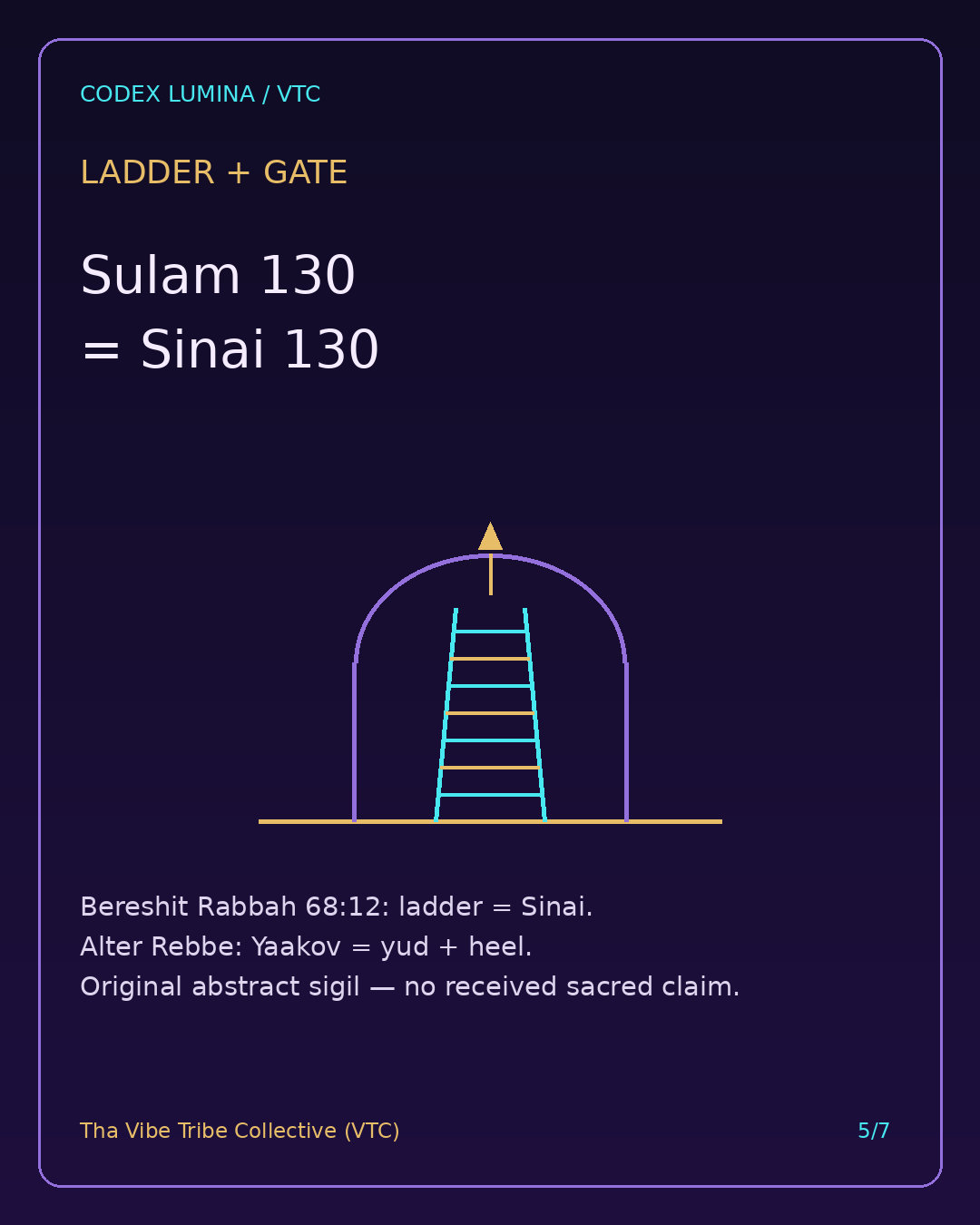
- Sourced gematria (Midrash): Bereshit Rabbah (68:12) reads “behold, a ladder” as Sinai and says the letters of one equal the letters of the other. sulam (סלם) = ס60 + ל30 + ם40 = 130; Sinai (סיני) = ס60 + י10 + נ50 + י10 = 130. (VTC checked the arithmetic.) In the same section the sages read the ladder as Sinai: it was “set on the earth” as Israel stood at the foot of the mountain, its top “reaching heaven” as the mountain burned to the heart of heaven, and the angels are read as Moshe and Aharon, with Moshe going up and coming down.
- Sourced midrashic reading: In the same midrash, Rabbi Chiya and Rabbi Yannai disagree: were the angels going up and down on the ladder, or on Yaakov? The Hebrew bo (בּוֹ) can mean either “on it” or “on him.”
- Sourced notarikon: Rabbi Pinchas Friedman (Shvilei Pinchas, Parshas Vayeitzei 5785, translated by Dr. Baruch Fox) reads even (אבן), stone, as an acronym for Bereishit (ב'ראשית), the first of the Ten Utterances of Creation, and “let us make man” (נ'עשה א'דם), the tenth. In his reading, the quarreling stones are those two all-inclusive utterances, joined into one stone. This is his chiddush, presented as his.
- Sourced letter reading: the Alter Rebbe’s yud + akev reading of Yaakov (יעקב) (section 3 above).
6. This Week in Time
The preparation week runs from Sunday, November 15, 2026 (5 Kislev 5787) to Shabbat Vayetzei, November 21 (11 Kislev 5787). Hebrew dates begin the evening before.
- 9 Kislev (Thursday, November 19): the birthday (1773) and day of passing (1827) of Rabbi DovBer of Lubavitch, the Mitteler Rebbe, son and successor of the Alter Rebbe. Chabad.org describes his teachings as “broadening rivers” flowing from his father’s wellspring.
- 10 Kislev (Friday, November 20): the anniversary of Rabbi DovBer’s liberation from imprisonment in 1826, celebrated in Chabad as a festival of liberation.
- Shabbat Vayetzei: Genesis 28:10–32:3. Haftarah: Hosea 12:13–14:10 (Ashkenazic); Hosea 11:7–12:12 (Sephardic).
VTC reflection: This week the Alter Rebbe’s wellspring and his son’s rivers meet our well-and-ladder theme. Learn one paragraph of Chassidus this week and let it flow outward into one conversation.
7. The Atbash Parasha Mirror: Vayetzei 7 ↔ Shoftim 48
Atbash Parasha Mirror series · framework by phEEnix
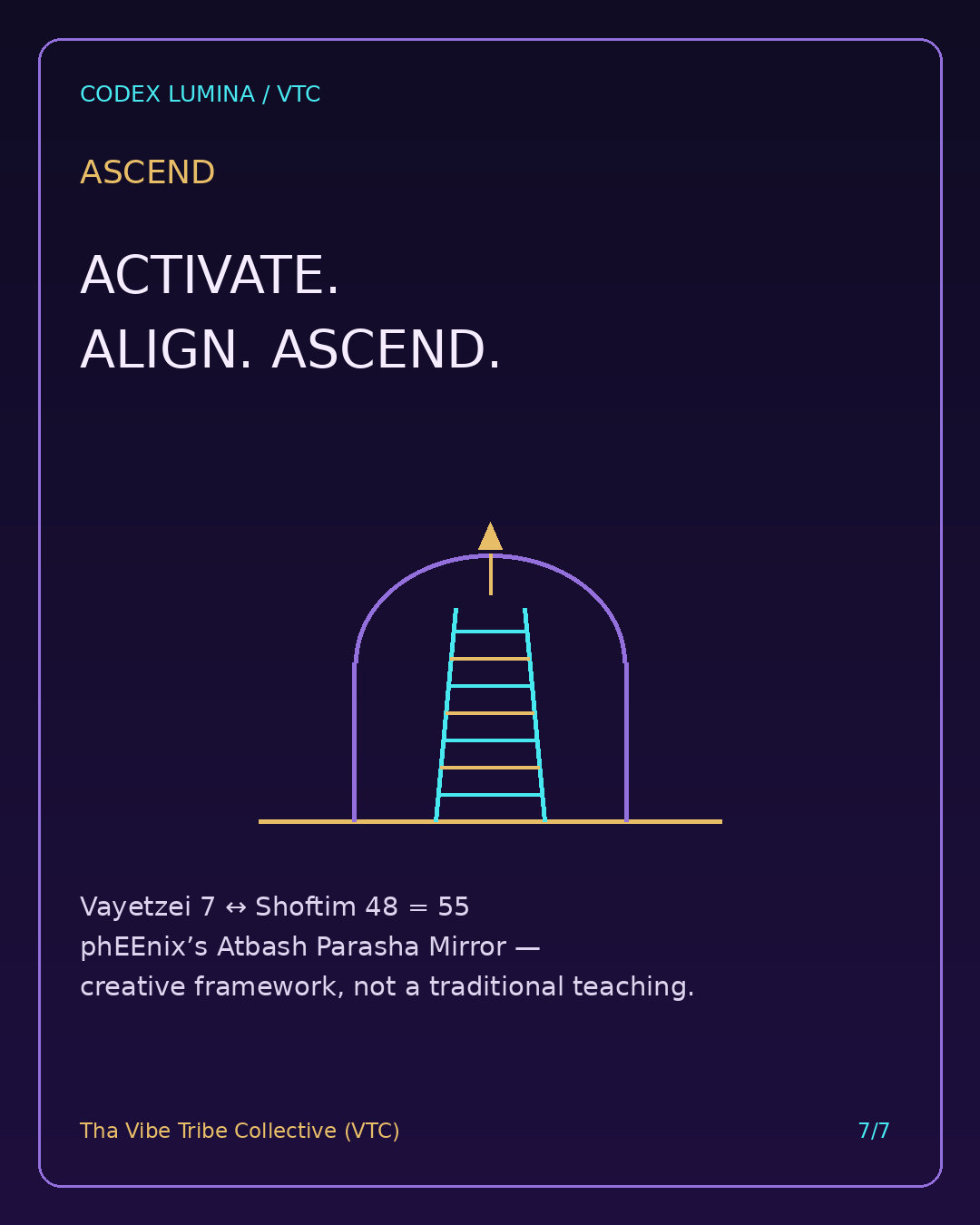
phEEnix’s numerical observation and VTC creative framework, not a teaching attributed to Chazal: in a reversed list of the 54 annual portions, number 7 pairs with number 48; 7 + 48 = 55. Hebcal confirms that Vayetzei is the 7th weekly portion and Shoftim is the 48th. This is a portion-order mirror, not Hebrew letter gematria and not proof of an ancient pairing.
Linguistic finding: Both portions use the root sha’ar (ש־ע־ר) (gate). Yaakov calls the place sha’ar hashamayim, “the gate of heaven” (Genesis 28:17). Shoftim opens with judges and officers to be appointed bechol she’arecha, “in all your gates” (Deuteronomy 16:18), meaning your settlements.
Creative VTC reading (labeled as such): Vayetzei shows the gate going up, where prayer rises. Shoftim shows the gates on the ground, where a community sets up justice. The mirror invites us to hold both: the ladder you climb at night and the fairness you practice by day. No traditional thematic pairing of these two portions is claimed.
8. VTC Frequency practice and Glowspell: One Rung Tonight
An original VTC reflective exercise inspired by these sources. It is not a traditional liturgical formula and does not replace any prayer.
- Find your place. Wherever you are tonight (car, kitchen, bedroom), stop. That is your makom.
- Breathe normally, within your comfort range.
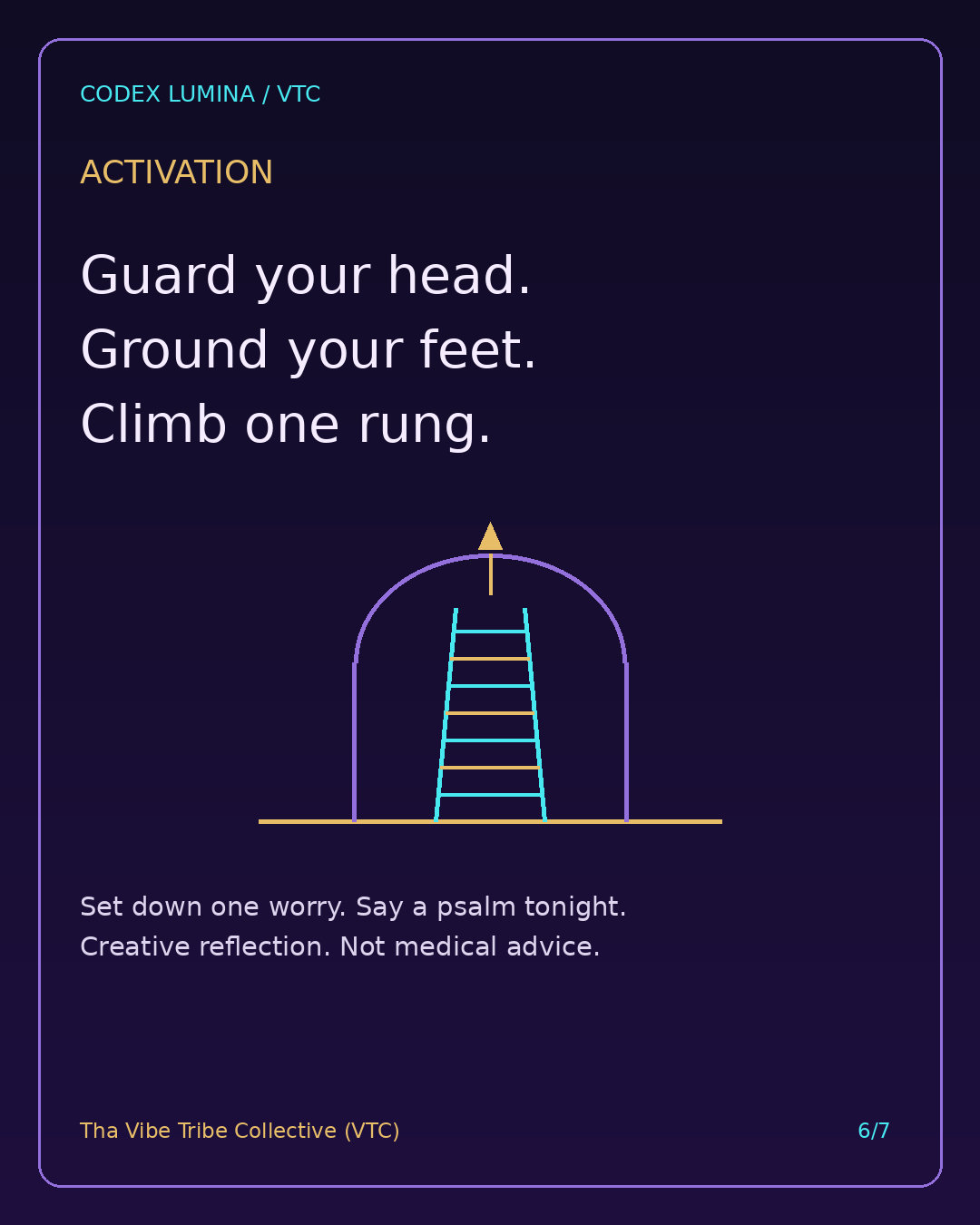
- Guard your head. Name one work worry, then set it down for these few minutes, the way Yaakov set stones around his head.
- Ground the ladder. Feel your feet on the floor. The ladder is “set on the earth.”
- Climb one rung. Say a few words of your own to Hashem, or say a chapter of Tehillim. Night prayer counts.
- Optional hum. If you like, hum a slow nigun or a steady tone for a few breaths as a focusing practice. This is a creative practice only. No special frequency or effect is claimed.
- Say the mantra: I stand where I am. I climb one rung. Every place can become a gate.
- Come down with something. Choose one fair, honest act for tomorrow (Shoftim’s “gates”).
This is creative reflection, not a health treatment. Not medical advice. No healing effect or guaranteed outcome is claimed.
Activate. Align. Ascend.
9. Sources and credits
- Torah: Genesis 28:10–22, Hebrew checked; English in this post is VTC paraphrase unless quoted: Genesis 28:10–22 — Sefaria
- Talmud Bavli, Berakhot 26b, Yaakov instituted the evening prayer (William Davidson Edition): Berakhot 26b — Sefaria
- Rashi on Genesis 28:11 and 28:17: Rashi on Genesis 28:11 — Sefaria · Rashi on Genesis 28:17 — Sefaria
- Bereshit Rabbah (68:12), ladder = Sinai, letters equal; Rabbi Chiya and Rabbi Yannai on bo (בּוֹ): Bereshit Rabbah (68:12) — Sefaria
- Rabbi Avraham Arieh Trugman / Ohr Chadash, “Jacob Left the Well of Seven Steadfast for Growth” (bringing Rebbe Natan of Breslov): Ohr Chadash — Rabbi Trugman
- Rabbi Avraham Arieh Trugman, Living With The Times, “Current Situation in Israel - The Ladder of Prayer”: The Ladder of Prayer — YouTube · Living With The Times playlist
- Rabbi Schneur Zalman of Liadi (Alter Rebbe), Torah Ohr, Vayetzei, discourse “Veshavti beShalom el Beit Avi,” opening paragraphs (Kehot text): Torah Ohr, Vayetzei — Sefaria
- L’Chaim Issue No. 36, Parshat Vayeitzei, 9 Kislev 5749 / November 18, 1988, “Living With The Times” (Lubavitch Youth Organization; adapted from the works of the Lubavitcher Rebbe), via the Torah4Blind archive: L’Chaim No. 36
- Tehillim 128:2: Psalms 128:2 — Sefaria
- Rabbi Pinchas Friedman, Shvilei Pinchas, Parshas Vayeitzei 5785, translated by Dr. Baruch Fox (even notarikon)
- Deuteronomy 16:18: Deuteronomy 16:18 — Sefaria
- Hebcal, Vayetzei 5787: November 21, 2026 / 11 Kislev 5787, portion and haftarah: Vayetzei 5787 — Hebcal · portion order: Vayetzei, 7th portion · Shoftim, 48th portion
- Chabad.org Jewish calendar, 9 and 10 Kislev 5787: 9 Kislev · 10 Kislev
- Atbash Parasha Mirror framework: phEEnix. Mantra, Glowspell, visual composition, and the unlettered Ladder-and-Gate sigil: original Tha Vibe Tribe Collective (VTC) creative synthesis. The sigil is an abstract design, not a received sacred symbol.
Source quotation, source paraphrase, linguistic finding and VTC creative interpretation are labeled separately above. No Zohar passage is used.
Activate. Align. Ascend. ⚡
phEEnix · VTC · L.I.T. = Love · Integrity · Truth · www.thavt.com
The Sigil Reel
Silent reel; no soundtrack. It is a quick visual teaser, not a standalone readable presentation of all supporting copy.

Slides